
Aflora Project Holds a Training Workshop with Indigenous Women in the Village of Limão Verde
An initiative funded by a budget amendment proposed by Federal Representative Camila Jara (PT-MS) empowers Indigenous leaders within organizations
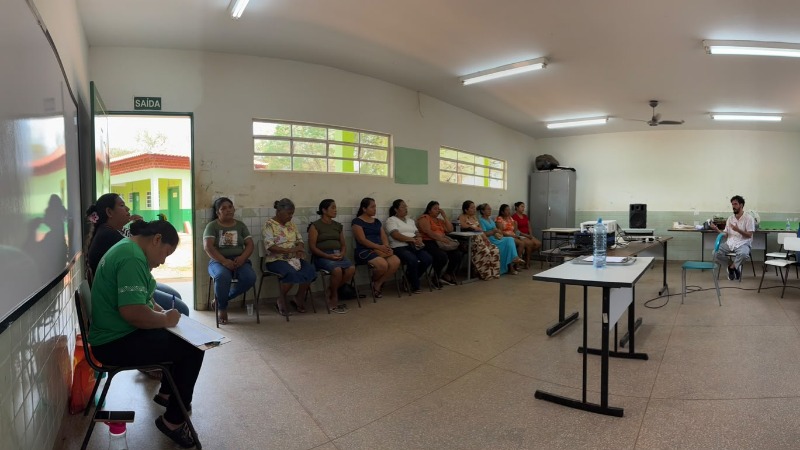
On November 1, the Aflora Project, implemented by the Oscip Flor e Espinho—which also manages the Mato Grosso do Sul Comitê de Cultural Committee (CCMS)—held a training workshop with Indigenous women from the Limão Verde Village in Aquidauana (MS).
Aflora is an initiative funded by a parliamentary amendment introduced by Federal Deputy Camila Jara (PT-MS) and aims to strengthen existing associations and promote women’s leadership within communities.
The workshop was led by Anderson Lima, a representative of Oscip Flor e Espinho, who provided guidance on formalizing associations, accessing public notices and public policies, and explained the difference between cooperatives and associations. The main objective was to train leaders of already established associations by offering technical support and practical guidance.
Community organizer Danielle Luiz highlighted the importance of the partnership and this learning opportunity:
We are here today on the Indigenous Territory in the village of Rio Verde, together with the women. It is a very important moment to welcome the Aflora Project from the Flor e Espinho Association, which stands with us in support of Indigenous women. We are nearing the end of the project and presenting to the community the importance of our association. It was a time of learning and partnership.
For Maricelma da Silva dos Santos Dias, president of the Xunako Senohiko Women’s Association of the Aldeia Limão Verde Indigenous Territory, the workshop provided essential knowledge:
For me, it was of the utmost importance. Every day we learn something new. I want to thank the people who came to encourage us to start this work.
The association’s vice president, Susan Malheiros, also gave the training a positive review:
I’m also very happy because we were able to learn things we didn’t know about our association. I thank God for this opportunity and the Flor e Espinho Association. It’s of the utmost importance to us as Indigenous women.
The meeting also served to provide guidance on documentation, administrative management, and access to public policies, preparing the leaders to strengthen their associations and expand their work to other villages in the region.
The Aflora Project continues to promote capacity-building initiatives in indigenous communities in Mato Grosso do Sul, strengthening women’s autonomy and the appreciation of local culture, in partnership with the Mato Grosso do Sul Comitê de Cultural Committee (CCMS).